Blog

  • Decoding Human Intent to Manipulate: How the World’s Largest Disavow Dataset Reveals Patterns of Deception

    Decoding Human Intent to Manipulate: How the World’s Largest Disavow Dataset Reveals Patterns of Deception

    After running one of the world’s most popular link analysis platforms for over a decade, we’ve accumulated something unprecedented in the AI training data landscape: the largest disavow dataset outside of Google itself. This treasure trove of real-world manipulation evidence represents millions of webmaster decisions about which sources were toxic enough to actively reject—and we’re using it as a powerful proxy for detecting human patterns of intent to manipulate across digital content.

    The Challenge of Detecting Intent to Manipulate in AI Training

    As AI companies race to train increasingly sophisticated language models, they face a critical challenge that goes beyond simple content quality: how do you detect when humans deliberately created content with intent to manipulate? Traditional approaches rely on surface-level signals—domain authority scores, publication dates, or basic spam detection. But these methods fundamentally miss the most insidious threat: sophisticated human actors who understand how to create content that appears legitimate while serving manipulative purposes.

    When AI models are trained on content created with manipulative intent, they don’t just risk producing inaccurate information—they learn the very patterns that human manipulators use to deceive. The model absorbs not just the false information, but the sophisticated techniques used to make that information appear credible.

    A Proxy for Human Manipulation Patterns

    Our disavow dataset represents something far more valuable than a simple catalog of “bad” websites—it’s a record of human decisions made when people recognized they were being targeted by deliberate manipulation campaigns. When someone adds a domain to their disavow file, they’re essentially saying: “I believe this source was created or operated with intent to manipulate the system and harm my site’s credibility.”

    These decisions capture the moment when humans identified patterns of manipulative intent that automated systems initially missed. The disavowed sources often represent sophisticated human efforts: content farms designed to look legitimate, link networks carefully constructed to appear natural, and manipulation campaigns that required human planning and coordination to execute.

    This makes our dataset a unique window into how humans actually attempt to manipulate digital systems—and crucially, how other humans learn to recognize and reject those attempts.

    Decoding the Fingerprints of Manipulative Intent

    Over the past decade, we’ve observed patterns in human manipulation behavior that would be impossible to detect through traditional content analysis:

    Evolution of Deception Tactics: We can track how human manipulators adapt their strategies over time, moving from crude spam to sophisticated content that mimics legitimate publishing. Our data reveals the learning curve of malicious actors.

    Coordinated Manipulation Networks: By analyzing which sources were disavowed together, we can identify when multiple domains were part of coordinated human campaigns designed to appear independent while serving the same manipulative goals.

    Psychological Manipulation Patterns: Certain content structures and presentation styles consistently appear in disavowed sources, revealing the psychological techniques humans use to make manipulative content appear trustworthy.

    Intent Versus Accident: We can distinguish between sources that became problematic due to neglect or poor judgment versus those that show clear patterns of deliberate manipulation—the difference between incompetence and malicious intent.

    Training AI to Recognize Human Deception Patterns

    At Evaltas.ai, we use this dataset as one component in our broader approach to understanding trust and manipulation. The disavow data serves as a powerful proxy for detecting human patterns of intent to manipulate—teaching our models to recognize the subtle signatures that indicate when content was created with deceptive purposes.

    Our AI models learn from millions of examples where humans successfully identified manipulative intent that automated systems initially missed. The models can detect the sophisticated techniques that malicious actors use: the careful balance of appearing legitimate while serving manipulative goals, the coordination patterns that indicate organized deception campaigns, and the psychological manipulation tactics embedded in content structure and presentation.

    This goes beyond simple content filtering—we’re teaching AI systems to think like human experts who have learned to spot the difference between genuine content and sophisticated manipulation attempts.

    Beyond Pattern Recognition: Predicting Manipulative Intent

    The real breakthrough isn’t just in identifying current manipulation—it’s in predicting when content shows early signs of manipulative intent. Our models can analyze content characteristics and identify patterns that match the fingerprints of sources that humans later recognized as deliberately deceptive.

    We can assign risk scores based on similarity to known manipulation patterns: “This content exhibits structural and stylistic characteristics that appeared in 78% of sources that humans later identified as manipulative campaigns” provides actionable intelligence that goes far beyond surface-level quality metrics.

    This predictive capability helps AI companies identify not just poor-quality content, but content that may have been specifically designed to deceive AI training processes.

    Understanding Human Deception at Scale

    While other approaches try to identify manipulation through automated content analysis, we’re working with evidence of human-to-human recognition of deceptive intent. Our trust assessments incorporate the collective wisdom of millions of people who learned to identify when they were being deliberately targeted by manipulation campaigns.

    This creates a fundamental advantage: instead of trying to reverse-engineer what manipulation looks like, we can learn from the accumulated experience of humans who became expert at recognizing it. As manipulation tactics evolve, our understanding evolves with them, capturing new patterns of human deceptive intent as they emerge.

    Implementation as Part of Comprehensive Trust Assessment

    Integrating this manipulation detection intelligence into AI training workflows represents just one component of our approach to understanding trust. The disavow dataset helps AI companies:

    • Identify deliberate deception patterns based on historical human recognition of manipulative intent
    • Reduce sophisticated false positives by distinguishing between content that appears low-quality versus content designed to deceive
    • Provide manipulation risk scores that complement other trust assessment mechanisms
    • Predict emerging deception tactics by identifying content that matches early-stage patterns of campaigns humans later recognized as manipulative

    This manipulation detection capability works alongside other trust signals to provide a more complete picture of content reliability and intent.

    Towards AI That Understands Human Deception

    This dataset represents one piece of a larger puzzle in building AI systems that can understand human intent and deception. By learning from real-world examples of how humans recognize and respond to manipulative intent, AI companies can train models that go beyond surface-level content analysis to understand the deeper patterns of human deception.

    As the AI industry matures, the ability to detect not just poor content but deliberately deceptive content will become increasingly critical. The challenge isn’t just filtering out mistakes or low-quality information—it’s identifying when humans have specifically crafted content to deceive AI training processes.

    Our disavow dataset provides a unique window into this human dimension of deception, complementing other approaches to create more robust trust assessment systems.

    The Human Element in AI Trust

    The stakes for understanding manipulative intent in AI training couldn’t be higher. When language models are trained on content created with deceptive purposes, they don’t just inherit false information—they learn the sophisticated patterns that humans use to make deception appear credible.

    By leveraging the largest record of human recognition of manipulative intent, AI companies can move beyond automated content analysis to understand the human psychology of deception. They can build models that recognize when content was created not just to inform, but to deliberately mislead.

    The challenge of AI trust isn’t just technical—it’s fundamentally human. Understanding how humans attempt to deceive, and how other humans learn to recognize that deception, provides critical intelligence for building truly trustworthy AI systems.


    Ready to enhance your AI’s ability to detect manipulative intent? Discover how Evaltas.ai’s comprehensive trust assessment platform, incorporating insights from the world’s largest manipulation detection dataset, can help you identify human patterns of deception in your training data.

  • The GEO Arms Race: How AI-Powered Manipulation is Outpacing Traditional Detection

    The GEO Arms Race: How AI-Powered Manipulation is Outpacing Traditional Detection

    The New Battlefield: From Search Rankings to AI Training

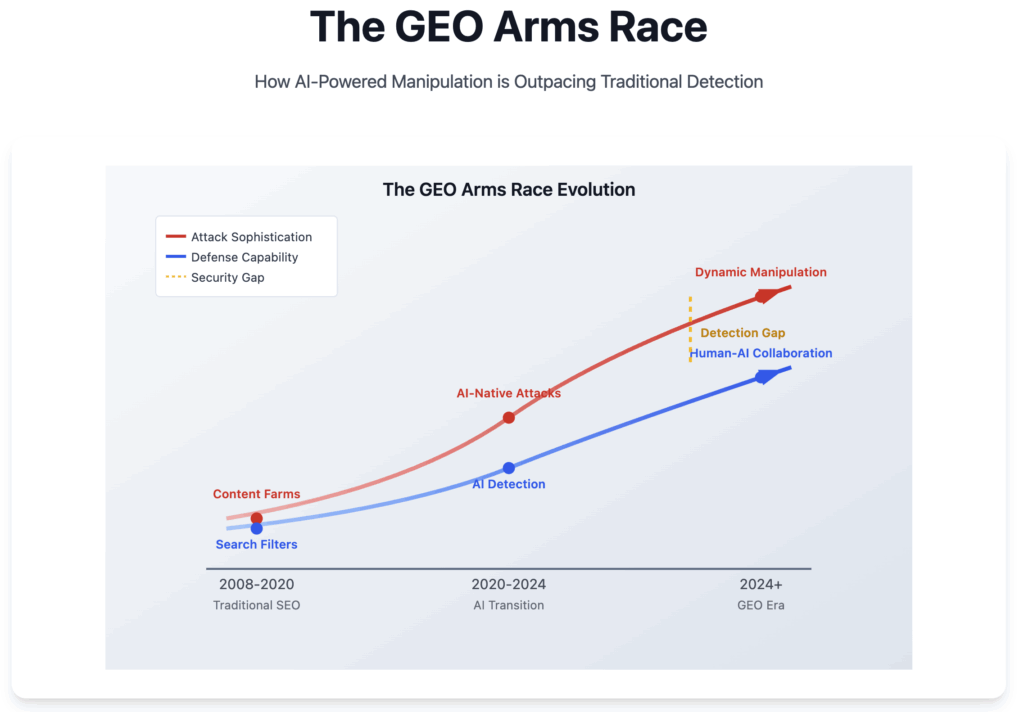
    For fifteen years, we’ve watched an escalating arms race between search engines and those trying to game them. PageRank manipulation, link farms, keyword stuffing—search engines eventually caught up to each tactic. But now we’re facing something fundamentally different: Generative Engine Optimization (GEO) isn’t just about fooling algorithms that rank pages. It’s about poisoning the very knowledge that AI systems learn from.

    The stakes have never been higher, and traditional detection methods are failing spectacularly.

    The Evolution of AI-Targeted Manipulation

    Generation 1: Content Farms Go AI-Native

    Traditional content farms were obvious—thin content, keyword stuffing, poor grammar. Today’s AI-powered content farms are sophisticated operations that produce seemingly authoritative articles at unprecedented scale. These aren’t the gibberish farms of 2010. They’re creating content that passes traditional quality filters while subtly embedding manipulation signals designed specifically for LLM consumption.

    We’re seeing networks that can generate thousands of topically-relevant articles daily, each one crafted to appear in LLM training datasets while carrying embedded biases or factual distortions. The content quality is often indistinguishable from legitimate sources—because the same AI tools creating the manipulation are being used by legitimate publishers.

    Generation 2: Prompt Injection Through “Helpful” Sources

    Perhaps the most insidious development is the emergence of sources that appear helpful and authoritative but contain hidden instructions designed to influence AI behavior. These aren’t obvious spam signals—they’re carefully crafted to exploit how LLMs process and prioritize information.

    Consider a seemingly legitimate medical information site that provides accurate health advice but subtly frames certain treatments as more effective than clinical evidence supports. Or technical documentation that appears authoritative but contains biased recommendations that favor specific vendors or approaches. Traditional spam detection misses these entirely because the content quality is high and the manipulation is sophisticated.

    Generation 3: Dynamic Manipulation at Scale

    The newest frontier involves content that adapts in real-time based on how it’s being accessed. We’re tracking sources that present different content to AI crawlers versus human visitors, or that modify their messaging based on detected training runs versus inference queries.

    This isn’t just cloaking—it’s intelligent manipulation that learns and adapts. Some sources are even experimenting with content that changes based on what other sites the crawler has recently visited, attempting to create contextual influence that compounds across multiple training sources.

    Protecting Your Training Data Investment

    While automated systems can process vast amounts of content, they struggle with the nuanced judgment calls that sophisticated manipulation requires. Human verification provides a critical defense layer—not for every source, but for the edge cases where millions of dollars in training investments hang in the balance.

    The key is building systems that combine automated detection with human expertise at the right scale. When AI systems can identify potentially problematic sources, human reviewers can make the contextual judgments that determine whether subtle bias patterns represent legitimate perspective or systematic manipulation.

    The Real Danger: Systematic Bias Injection

    The goal of modern GEO isn’t to create obvious spam—it’s to subtly shift the knowledge base that AI systems learn from. Imagine thousands of sources that are 95% accurate but consistently present certain political viewpoints, commercial interests, or factual frameworks as more authoritative than they actually are.

    The cumulative effect isn’t a few bad sources in training data—it’s a systematic skewing of how AI systems understand truth, authority, and reliability. This kind of manipulation can influence AI behavior in ways that are nearly impossible to detect after the fact.

    What’s Coming Next

    Our analysis suggests we’re moving toward even more sophisticated manipulation:

    • Adversarial content optimization: Sources that specifically test their content against detection systems and iterate to evade detection
    • Cross-platform coordination: Manipulation campaigns that coordinate across multiple platforms to create false consensus
    • Real-time adaptation: Content that modifies itself based on detection attempts

    The Infrastructure We Need

    Fighting this arms race requires detection systems built specifically for the AI era:

    • Pattern recognition at scale: Systems that can identify subtle bias patterns across millions of sources
    • Behavioral analysis: Detection that focuses on systematic manipulation rather than content quality
    • Human-AI collaboration: Combining automated detection with human expertise for nuanced judgment calls
    • Real-time adaptation: Detection systems that evolve as quickly as the manipulation tactics

    The future of AI trustworthiness depends on our ability to stay ahead of this arms race. Those building AI systems today need to assume their training data is under active attack—and build accordingly.

  • Building Human Intelligence Into AI at Scale: The DHO Layer

    Building Human Intelligence Into AI at Scale: The DHO Layer

    The Challenge of Human Opinion at Machine Scale

    As AI systems become more sophisticated, one critical question emerges: how do we incorporate reliable human judgment into AI training data without sacrificing speed or consistency? The answer lies in what we call the Distributed Human Opinion (DHO) layer—a framework that captures authentic human perspectives at the scale AI demands.

    What Is the DHO Layer?

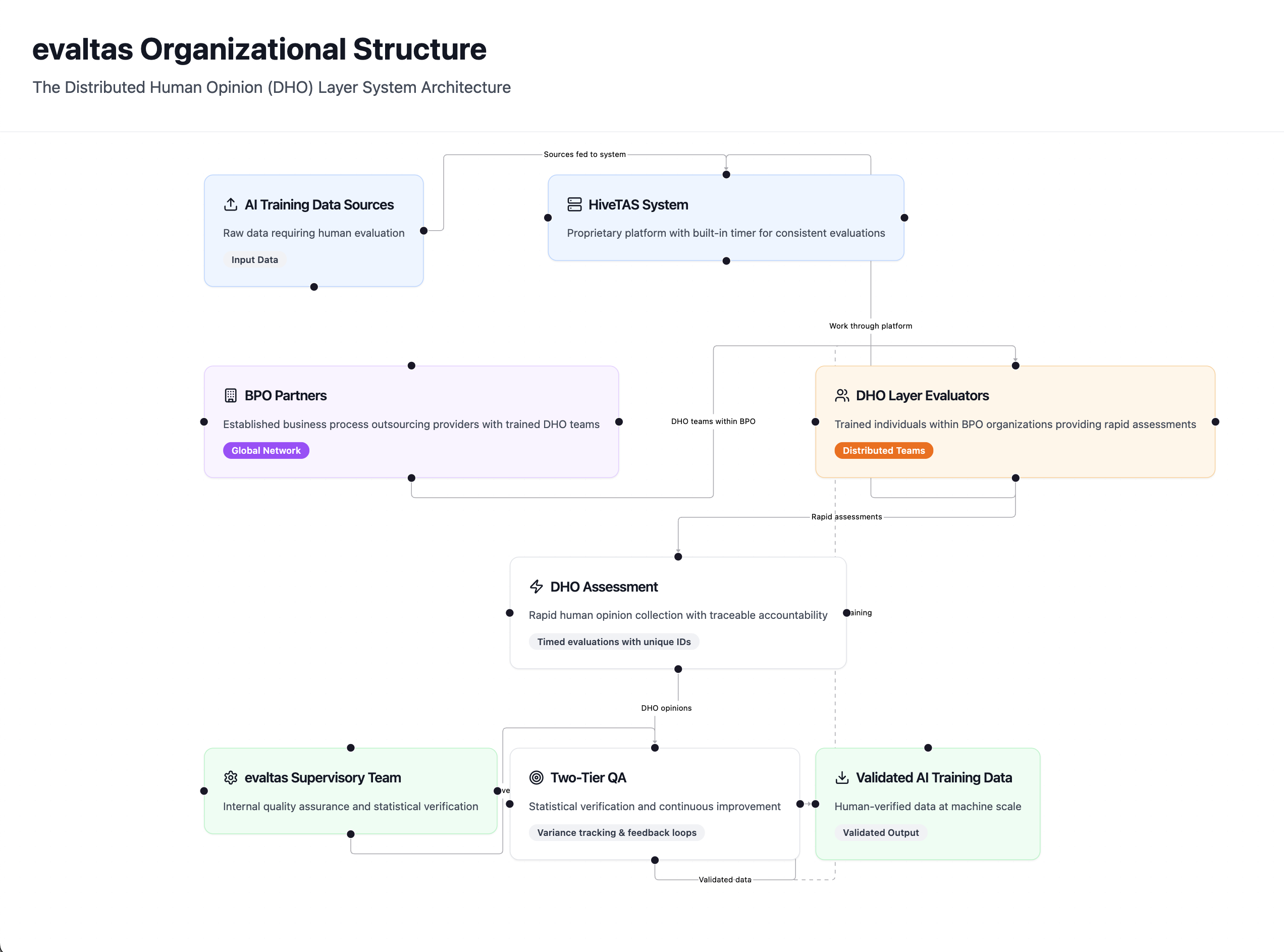
    The DHO layer is our systematic approach to recording human opinions about AI sources at unprecedented scale. Think of it as quality control for the information that trains tomorrow’s AI systems, but designed for the reality of processing millions of data points.

    Here’s how it works:

    The HiveTAS System: Our proprietary platform presents sources to human evaluators with a built-in timer, ensuring we capture genuine first impressions while maintaining consistent cost-per-opinion economics. This isn’t about rushed decisions—it’s about replicating how humans naturally assess information credibility in real-world scenarios.

    Distributed Expertise: We partner with established Business Process Outsourcing (BPO) providers like Lionbridge, each bringing trained individuals who work within our HiveTAS ecosystem. This distributed model gives us global reach while maintaining quality standards.

    Traceable Accountability: Every opinion is tagged with a unique identifier that traces back to the individual evaluator. This creates a certificate of conformity—complete transparency about who made each assessment and when.

    The Two-Tier Quality Assurance Model

    Raw human opinion isn’t enough. Our EvalTAS supervisory team provides the critical second layer:

    Statistical Verification: Our internal team evaluates a statistically significant percentage of DHO assessments without time constraints, providing deeper analysis that validates the rapid-fire DHO evaluations.

    Continuous Improvement: When our supervisory team identifies opinions outside expected parameters, those insights become training inputs for the DHO layer. This creates a feedback loop that continuously improves evaluation quality.

    Quality Metrics: We track variance between DHO and supervisory assessments, building comprehensive quality assurance metrics that inform both individual training and system-wide improvements.

    Why This Matters for AI’s Future

    As we race toward more powerful AI systems, the temptation is to automate everything. But human judgment remains irreplaceable for nuanced assessments of credibility, bias, and manipulation. The DHO layer solves the false choice between human insight and machine scale.

    The result? AI training data that combines the speed and consistency of automated systems with the nuanced judgment that only humans can provide—at the scale modern AI development demands.

  • Building Fair Compensation: How We Benchmark Pay Scales for Our Global Remote Workforce

    Building Fair Compensation: How We Benchmark Pay Scales for Our Global Remote Workforce

    As companies increasingly embrace remote work and tap into global talent pools, one of the most critical challenges we face is ensuring fair compensation across diverse markets. At Evaltas.ai, with team members spanning from Dhaka, Bangladesh to the Philippines, we’ve developed a comprehensive approach to benchmarking pay scales that ensures our remote workforce receives competitive, fair wages relative to their local markets and skill levels.

    The Challenge of Global Pay Equity

    When building a remote workforce across different countries, the temptation might be to apply a one-size-fits-all approach to compensation or simply pay the lowest possible rates. However, this approach is both ethically questionable and strategically shortsighted. Our philosophy centers on the principle that talent deserves fair compensation regardless of geographic location, while also recognizing the economic realities of different markets.

    Our Benchmarking Methodology

    1. Market-Relative Compensation Baskets

    Rather than using arbitrary rates, we benchmark our positions against a carefully curated basket of similar skilled roles within each local market. This approach ensures our team members are compensated fairly relative to their peers and the value they could command locally.

    For each role, we analyze:

    • Similar positions in the local tech sector
    • Comparable roles in multinational companies operating in the region
    • Government salary data for equivalent skill levels
    • Industry-specific compensation surveys

    2. Skill-Level Calibration

    We don’t just look at job titles, we evaluate the actual skills, responsibilities, and impact of each role. Our supervisory positions, for instance, are benchmarked against professional roles that require similar levels of expertise and responsibility. In markets like Bangladesh, this means our senior supervisors earn compensation equivalent to what a doctor might make locally, recognizing that their specialized skills and leadership responsibilities deserve commensurate pay.

    3. Regular Market Reviews

    Compensation benchmarking isn’t a set-it-and-forget-it process. We conduct quarterly reviews of our compensation baskets to ensure they remain current with market conditions, inflation rates, and evolving skill demands in each region.

    The Benefits of Fair Benchmarking

    For Our Team Members

    • Competitive local purchasing power: Our team members can maintain high standards of living in their communities
    • Career progression clarity: Clear understanding of how skills development translates to compensation growth
    • Retention and stability: Fair pay reduces turnover and builds long-term commitment

    For Our Business

    • Access to top talent: Competitive compensation attracts the best candidates in each market
    • Reduced recruitment costs: Lower turnover means less time and money spent on hiring
    • Enhanced productivity: Fairly compensated team members are more engaged and productive
    • Brand reputation: Our commitment to fair pay enhances our reputation as an employer of choice

    Implementation Considerations

    Data Sources and Validation

    We utilize multiple data sources to ensure accuracy:

    • Local recruitment agencies and their market reports
    • Government statistical offices
    • Professional associations and industry bodies
    • Anonymous salary surveys within our professional networks

    Balancing Local Markets with Global Standards

    While we benchmark locally, we also ensure our compensation philosophy aligns with our company values. This sometimes means paying above local market rates when we believe the market itself undervalues certain skills or when we want to attract exceptional talent.

    Transparency and Communication

    We maintain transparency with our team about our compensation philosophy, though specific salary details remain confidential. Team members understand how their roles are benchmarked and what factors influence their compensation levels.

    Challenges and Lessons Learned

    Currency Fluctuations

    Operating across multiple currencies requires careful planning and sometimes necessitates compensation adjustments to maintain real purchasing power.

    Market Data Availability

    In some markets, reliable salary data can be scarce. We’ve learned to triangulate from multiple sources and sometimes rely on proxy indicators when direct data isn’t available.

    Balancing Equity Across Regions

    Ensuring internal equity while respecting local market conditions requires ongoing calibration and clear communication about our methodology.

    Looking Forward: The Future of Global Compensation

    As remote work continues to evolve, we expect to see:

    • More standardized global compensation frameworks
    • Increased transparency in salary benchmarking
    • Greater emphasis on skills-based rather than location-based pay
    • Advanced tools for real-time market data analysis

    Building a fair compensation structure for a global remote workforce requires intentionality, regular review, and a commitment to treating talent equitably regardless of location. By benchmarking against appropriate local markets while maintaining high standards for the value we place on skills and contribution, we’ve created a compensation framework that serves both our business objectives and our team members’ career aspirations.

    The investment in fair compensation pays dividends in team loyalty, productivity, and our ability to attract top talent from around the world. As we continue to scale our global operations, this foundation of fair pay will remain central to our people strategy.